



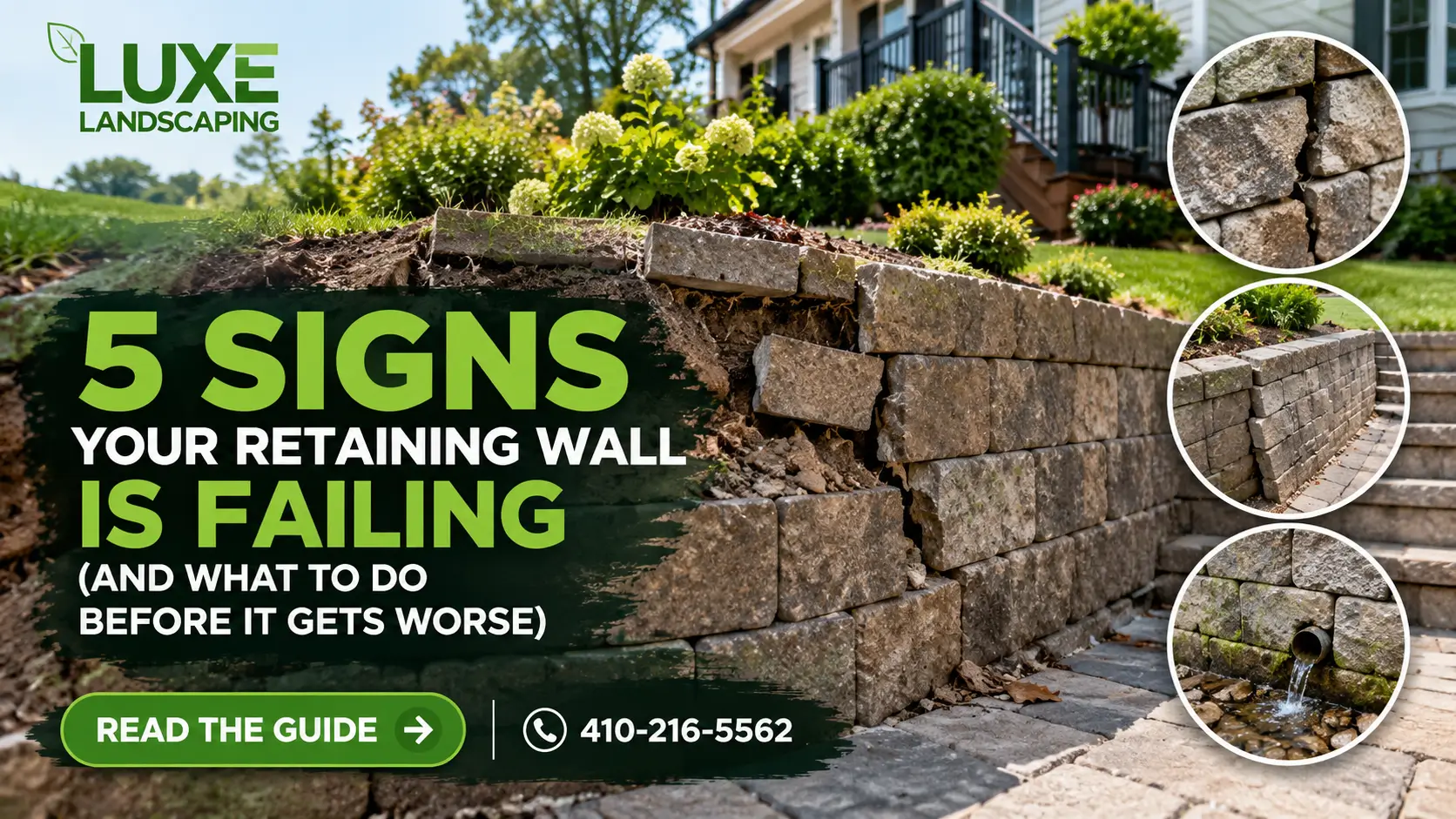
A retaining wall is supposed to hold soil in place, manage grade changes, and help protect the surrounding landscape. When it starts moving, cracking, or losing support, the problem can become more serious than an unattractive wall.
Recognizing the signs of retaining wall failure early gives homeowners a chance to investigate the cause before soil movement damages nearby patios, walkways, planting beds, fences, or other outdoor features.
This is especially important in Anne Arundel County, where steep properties, heavy rain, drainage issues, and waterfront erosion can place additional pressure on retaining systems.
Luxe Landscaping designs and builds retaining walls and seating walls for homeowners throughout Annapolis and surrounding Maryland communities.
5 Signs of Retaining Wall Failure You Should Not Ignore
Some wall movement develops slowly. Other problems become noticeable after a heavy storm or prolonged wet period.
These five warning signs deserve attention.
1. The Wall Is Leaning or Bowing
A retaining wall should not suddenly begin leaning outward.
When the center of the wall starts bowing or the entire structure appears to be tilting downhill, pressure behind the wall may be exceeding what it can safely resist.
Possible causes include:
- Poor drainage
- Excess water pressure
- Inadequate reinforcement
- Weak foundation conditions
- Improper backfill
- Additional weight above the wall
What Should You Do?
Do not assume a leaning wall will remain stable because it has not fallen yet.
Monitor whether the movement is progressing and have the wall evaluated, particularly if it supports a driveway, patio, steep slope, deck area, or heavily used portion of the yard.
2. Cracks Are Growing or Blocks Are Separating
Small surface imperfections are not always structural problems, but widening cracks deserve closer attention.
For segmental block walls, look for spaces opening between units, shifting capstones, uneven rows, or sections that no longer line up.
Concrete or masonry walls may show:
- Horizontal cracks
- Stair-step cracking
- Large vertical cracks
- Separation at corners
- Cracks that become wider over time
These can be signs that the wall is experiencing movement rather than normal cosmetic aging.
3. Soil Is Washing Out Around or Under the Wall
Soil loss is one of the clearest warning signs that the surrounding site is changing.
You might notice:
- Small holes developing behind the wall
- Soil washing through joints
- Depressions above the wall
- Exposed base material
- Gaps near the ends of the wall
- Mulch and soil repeatedly washing downhill
On waterfront properties, washout may also indicate that shoreline erosion or stormwater runoff is affecting the slope.
Ignoring soil loss can allow voids to develop behind or beneath the structure.
4. Water Is Collecting Behind the Wall
Drainage is one of the most common causes of retaining wall failure.
Research into earth-retaining structures identifies poor drainage as a major contributor to performance problems because trapped groundwater creates additional pressure against the wall.
Look for:
- Standing water behind the wall
- Constantly saturated soil
- Water flowing through random joints
- Muddy areas after storms
- Block discoloration from persistent moisture
- Drain outlets that appear clogged
A properly designed retaining system usually needs a way to move water away from the structure.
If drainage stops functioning, pressure can continue increasing behind the wall.
5. The Ground Above the Wall Is Sinking or Pulling Away
Do not inspect only the face of the wall.
The area behind it can reveal important warning signs.
A developing depression, crack in the soil, sinking patio edge, or gap behind the top of the wall may indicate that backfill is shifting or washing away.
This becomes more urgent when the wall supports:
- A patio
- Walkway
- Driveway
- Pool area
- Deck access
- Outdoor kitchen
- Steep backyard slope
Movement above the wall can indicate that the issue extends beyond a few loose blocks.
What Causes Retaining Wall Failure?
Understanding the causes of retaining wall failure is important because repairing the visible damage without fixing the underlying problem may only provide a temporary solution.
Poor Drainage
Water adds pressure behind a wall.
If gravel, drainage pipe, outlets, or grading were installed incorrectly or have stopped working, hydrostatic pressure can push the wall outward.
Weak or Improper Base Preparation
A retaining wall needs stable support below it.
If the base settles unevenly, individual sections may drop, rotate, or separate.
Improper Backfill
The material behind a wall affects both drainage and pressure.
Unsuitable soil, poor compaction, or incorrect installation can contribute to movement later.
Too Much Weight Above the Wall
A wall may experience more pressure than originally intended if a driveway, large structure, patio, pool, or other heavy feature is later installed nearby.
These added loads are sometimes called surcharge loads.
Erosion
Water moving around the wall can remove the soil that provides support.
This is particularly important around sloped and waterfront properties.
Retaining Wall Repair vs Replacement in Maryland
Not every damaged wall needs to be completely rebuilt.
The right choice depends on what has failed.
When Repair May Be Reasonable
Localized repair may be possible when:
- Only a small section has shifted
- Drainage can be corrected
- The wall remains generally stable
- A few blocks or caps are damaged
- Localized settling can be addressed
- The original wall system is still suitable
A contractor may be able to remove part of the wall, correct the base or drainage, and rebuild that section.
When Replacement May Make More Sense
Replacement may be the safer long-term approach when:
- Much of the wall is leaning
- Multiple areas have failed
- The foundation is inadequate
- Drainage was never installed properly
- The wall is undersized for the soil it retains
- Major erosion has occurred
- Structural reinforcement is insufficient
- Previous repairs keep failing
Retaining wall repair vs replacement in Maryland should be based on the condition of the complete system, not simply the visible surface.
Erosion Warning Signs on Chesapeake Bay Properties
Waterfront homes deserve additional attention because erosion can come from multiple directions.
Homeowners should watch for Chesapeake Bay erosion warning signs such as:
- Shoreline retreat
- Newly exposed tree roots
- Soil disappearing after storms
- Gullies developing down a slope
- Bare soil near the water
- Sinkholes or depressions
- Increasingly saturated areas
- Retaining walls beginning to tilt
- Patios or walkways settling near slopes
Anne Arundel County's Critical Area generally includes land within 1,000 feet of tidal waters and tidal wetlands, with additional rules applying closer to the shoreline.
Shoreline Walls Are Not Always Standard Retaining Walls
A wall that holds an upland landscape grade is different from a bulkhead, seawall, revetment, or other structure directly protecting tidal shoreline.
Anne Arundel County also gives preference to vegetation and less structural shoreline erosion-control approaches before bulkheads or seawalls where site conditions allow.
For waterfront homeowners, identifying the type of erosion problem should come before deciding what structure to build.
Who Is Responsible for Retaining Wall Failure?
There is no universal answer.
Who is responsible for retaining wall failure may depend on:
- Who owns the wall
- Where the property boundary is located
- Whether an easement exists
- Who originally constructed the wall
- Who changed the surrounding grade
- Whether neighboring construction contributed to the problem
- Maintenance obligations
- Private agreements between property owners
- The actual cause of the failure
A wall that appears to sit on a boundary should not automatically be assumed to belong equally to both neighbors.
If ownership or liability is disputed, homeowners may need a current property survey and advice from an appropriate Maryland legal professional before authorizing major construction.
Luxe Landscaping can evaluate the landscape and construction aspects of a wall, but property ownership and legal responsibility should be confirmed separately when they are unclear.
Does Insurance Cover Retaining Wall Failure?
Sometimes, but not automatically.
The answer to "does insurance cover retaining wall failure?" depends heavily on why the wall failed and what your specific policy covers.
Maryland Insurance Administration guidance explains that homeowners policies commonly provide protection for sudden and accidental losses caused by covered events, while exclusions can apply to flood, earth movement, deterioration, and maintenance-related damage.
That distinction matters.
Gradual Failure May Be Treated Differently
A wall that slowly deteriorates because of poor drainage, aging, settlement, neglected maintenance, or long-term soil movement may be treated differently from damage caused suddenly by a covered event.
Standard homeowners policies also generally do not cover flood damage.
Because every policy is different, contact your insurer before assuming that repairs are either covered or excluded.
Take photographs of the damage, document when you first noticed it, and keep records of any professional assessments.
What Should You Do When a Retaining Wall Starts Failing?
The first priority is understanding the cause.
Avoid simply pushing blocks back into position or filling visible cracks without knowing why the movement occurred.
A useful evaluation should consider:
- Wall height and length
- Degree of leaning or movement
- Drainage behind the wall
- Condition of the base
- Soil loss or erosion
- Loads above the wall
- Nearby patios, driveways, or structures
- Waterfront or Critical Area conditions
Anne Arundel County currently requires permits for residential retaining walls over 24 inches, so significant replacement work may also involve permitting and construction-plan requirements.
For larger structural issues, engineering may be appropriate before rebuilding.
Protect the Rest of Your Outdoor Space
A failed retaining wall rarely affects only the wall.
Movement can impact adjacent landscaping, pavers, stairs, drainage, planting beds, and usable outdoor areas.
When rebuilding is necessary, it can be an opportunity to correct the original problem and coordinate the wall with the rest of the yard.
Luxe Landscaping can incorporate retaining walls into complete outdoor living designs, including patios, walkways, planting, grading, and other landscape improvements.
You can also browse completed Luxe Landscaping projects and view Luxe Landscaping's Google reviews while researching a contractor.
If you notice leaning, cracking, soil loss, poor drainage, or other signs of retaining wall failure, contact Luxe Landscaping to discuss the condition of your wall and the surrounding property before the problem becomes more extensive.
Frequently Asked Questions
What are the first signs of retaining wall failure?
Common early signs include leaning, bowing, widening cracks, separated blocks, soil washout, standing water behind the wall, and sinking ground above it.
What are the most common failures of retaining wall systems?
Common failures of retaining wall systems include overturning, sliding, settlement, drainage-related movement, erosion around the base, and localized structural deterioration. The actual cause should be evaluated before repairs begin.
What is the biggest cause of retaining wall failure?
Poor drainage is one of the most important causes because trapped water increases pressure behind the wall. Weak foundations, erosion, incorrect construction, unsuitable backfill, and excessive loads can also contribute.
Should a leaning retaining wall be repaired immediately?
A noticeably leaning wall should be evaluated promptly, particularly if it supports a steep slope, patio, driveway, or frequently used area. Progressive movement can become more difficult and expensive to correct.
Does insurance cover retaining wall failure in Maryland?
Coverage depends on your individual policy and the cause of damage. Gradual deterioration, maintenance issues, earth movement, and flooding may be excluded, while some sudden covered events may receive different treatment. Confirm coverage directly with your insurer.
Who is responsible for a retaining wall between two properties?
Responsibility depends on ownership, the property line, easements, agreements, construction history, and what caused the failure. A survey and professional legal advice may be necessary when ownership is disputed.
Is repairing a retaining wall cheaper than replacing it?
Localized repairs can cost less when the underlying system remains sound. If the base, drainage, reinforcement, or large sections of the wall have failed, rebuilding may provide better long-term value than repeated repairs.
Do I need a permit to replace a retaining wall in Anne Arundel County?
Anne Arundel County currently states that residential retaining walls over 24 inches require a permit. Replacement scope, wall height, location, and waterfront conditions can affect additional requirements.

Ready to Transform Your Backyard?