



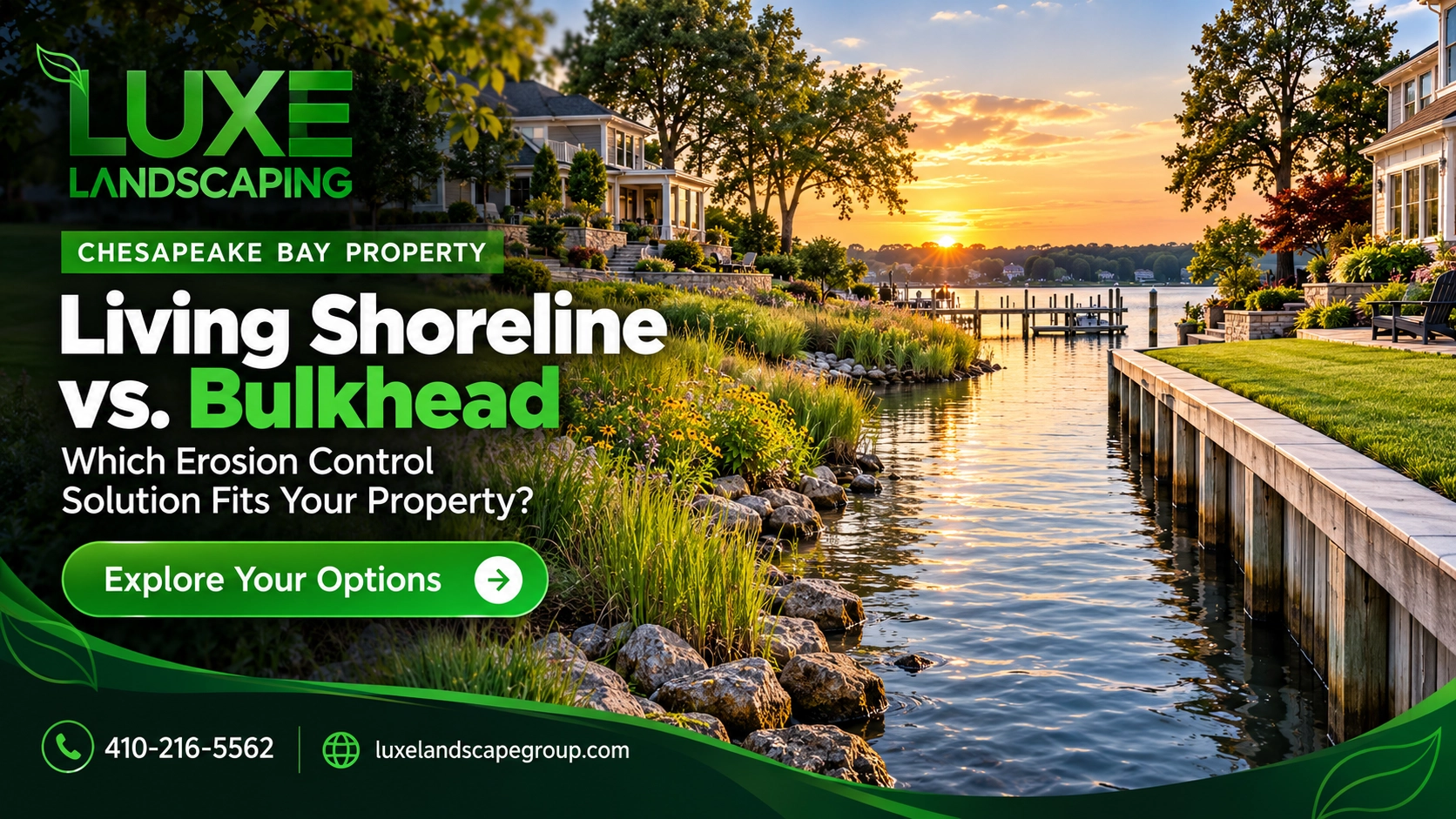
Watching part of your waterfront slowly disappear can turn shoreline erosion from a cosmetic concern into a serious property issue. Homeowners along the Chesapeake Bay and its tributaries may notice exposed roots, collapsing banks, muddy runoff, lost lawn area, or increasing damage after storms.
When researching solutions, one comparison comes up frequently: living shoreline vs bulkhead in Chesapeake Bay properties.
Both approaches are intended to address erosion, but they work very differently. More importantly, Maryland does not treat them as interchangeable choices. Living shorelines are generally the preferred approach for shoreline stabilization, while structural options such as bulkheads may only be appropriate when site conditions justify them.
For homeowners in Anne Arundel County, understanding those differences early can save time and help create a shoreline plan that fits the property, local conditions, and permitting requirements.
What Is a Living Shoreline?
A living shoreline uses natural or nature-based materials to reduce erosion while maintaining important shoreline processes.
Depending on the property, a design may include:
- Native marsh grasses
- Sand or beach nourishment
- Stone sills
- Coir or biodegradable materials
- Low rock structures
- Breakwaters
- Native shoreline vegetation
- Combinations of planted and structural elements
The exact design depends on wave energy, shoreline slope, water depth, erosion rate, existing vegetation, and available space.
Maryland describes living shorelines as a collection of techniques rather than one fixed design. Some properties may need a simple planted shoreline, while others may require stone sills, breakwaters, or similar features combined with vegetation.
What Is a Bulkhead?
A bulkhead is a hard structural barrier installed along a shoreline to hold soil in place and separate upland property from the water.
Bulkheads are commonly built using materials such as:
- Vinyl
- Timber
- Concrete
- Steel
- Other engineered structural systems
Unlike a living shoreline, a bulkhead creates a relatively firm vertical edge.
This can be useful in certain difficult shoreline conditions, but it can also change how wave energy interacts with the shoreline. Because of those environmental and site considerations, Maryland generally requires property owners to consider nonstructural shoreline stabilization before moving directly to a bulkhead.
Living Shoreline vs Bulkhead in Chesapeake Bay: What Are the Main Differences?
The right way to compare the two is not simply by appearance or price.
Homeowners should consider how each system works with the shoreline.
Living Shorelines Work With Natural Conditions
Living shorelines are designed to reduce erosion while preserving or rebuilding natural shoreline habitat.
Vegetation and natural materials can help:
- Hold soil in place
- Slow wave energy
- Capture sediment
- Create habitat
- Maintain a more natural transition from land to water
- Support water-quality goals
A properly designed living shoreline can also change over time as plants mature and sediment accumulates.
Bulkheads Create a Hard Shoreline Edge
Bulkheads rely on a rigid structure to retain upland soil.
They may be considered where site conditions make a living shoreline impractical, such as areas with severe wave energy, extreme water depth, excessive erosion, narrow waterways, or other physical constraints.
Maryland's regulations specifically recognize several of these conditions when determining whether a property may qualify for a living shoreline waiver.
Does Maryland Prefer Living Shorelines Over Bulkheads?
Yes.
This is especially important for homeowners researching shoreline erosion control options in Maryland.
Under Maryland's living shoreline regulations, shoreline erosion protection generally must use marsh creation or another nonstructural stabilization approach unless a waiver is obtained or the site qualifies for structural stabilization.
Anne Arundel County follows a similar hierarchy.
The County states that vegetation should be used unless it is demonstrated to be ineffective. If another approach is required, its preference progresses through methods such as vegetation with stone structures, beach nourishment, riprap, and then structural methods such as bulkheads or seawalls when site conditions make other measures impractical.
This means choosing between a living shoreline and bulkhead is not only a design decision. Permitting feasibility matters too.
Which Properties Are Better Candidates for Living Shorelines?
Living shorelines can work on many Chesapeake Bay properties, but every site should be evaluated individually.
Lower to Moderate Wave Energy
Protected coves, creeks, rivers, and shorelines with manageable wave exposure may offer good conditions for nature-based stabilization.
Room for a Gradual Shoreline Transition
Living shoreline projects often need room for vegetation, sand, stone, or other components between the upland property and the water.
Homeowners Who Want a Natural Waterfront Appearance
For homeowners who value views, habitat, vegetation, and a softer waterfront edge, living shorelines can integrate well with the surrounding landscape.
Maryland also provides a Shoreline Stabilization Mapper that considers factors such as water depth, fetch, marsh presence, bank height, vegetation, and nearby structures when evaluating potential stabilization approaches.
When Might a Bulkhead Be Considered?
There are properties where a living shoreline may not provide a practical solution on its own.
Potential conditions include:
- Severe wave exposure
- Deep water close to shore
- High erosion rates
- Very limited shoreline space
- Extremely steep banks
- Narrow waterways
- Existing infrastructure close to the water
- Site conditions that make natural stabilization ineffective
Even in those cases, homeowners should not assume that a bulkhead can automatically be installed.
A structural shoreline project may require a Maryland Department of the Environment waiver as part of the approval process.
What Other Shoreline Erosion Control Options Are Available in Maryland?
The choice is not always limited to a planted shoreline or a vertical bulkhead.
Other shoreline erosion control options in Maryland can include:
Stone Sills
A low stone structure placed offshore or along the shoreline can help reduce wave energy while supporting marsh vegetation.
Riprap
Loose stone can stabilize a shoreline while allowing more water movement than a solid vertical wall.
Beach Nourishment
Sand may be added in suitable locations to rebuild or expand a beach area and provide additional shoreline protection.
Breakwaters
Offshore structures can help reduce wave energy before it reaches the bank.
Hybrid Solutions
Some properties benefit from a combination of stone, sand, native vegetation, grading, and other stabilization methods.
Maryland DNR notes that living shoreline projects can use multiple techniques together based on site conditions rather than relying on a single standard design.
What Should Anne Arundel County Homeowners Evaluate First?
Waterfront erosion solutions in Anne Arundel County should start with the property itself.
Look at the Erosion Pattern
Is the shoreline gradually retreating, or does most damage happen after storms?
Understanding how and where soil is being lost can help determine what type of stabilization needs to be evaluated.
Consider Drainage From the Property
Not all erosion comes from waves.
Stormwater flowing toward the shoreline can cut channels into a slope, wash soil downhill, or create pressure around existing walls.
Upland drainage should therefore be considered alongside shoreline stabilization.
Evaluate Existing Retaining Walls
A retaining wall farther inland serves a different purpose from a bulkhead located directly along tidal water.
Luxe Landscaping provides retaining wall and seating wall solutions for landscape slopes, grade changes, erosion concerns, and outdoor living areas.
Homeowners should determine whether their problem involves shoreline stabilization, upland grade retention, or both.
Do Living Shorelines and Bulkheads Require Permits?
Shoreline work in Maryland should be planned with permitting in mind from the beginning.
Maryland DNR states that work below the average high tide line in tidal wetlands or tidewater requires authorization through the Maryland Department of the Environment. Federal, State, Critical Area, grading, sediment-control, and local requirements may also apply depending on the project.
Shore erosion control projects also require coordination involving MDE and local government review.
Because permitting varies by project, homeowners should confirm requirements before excavation, vegetation removal, grading, or shoreline construction begins.
How Can Shoreline Protection Fit Into the Rest of Your Property?
Erosion control should not be considered in isolation.
For many Chesapeake Bay homeowners, the shoreline connects directly with lawns, slopes, drainage areas, planting beds, patios, walkways, decks, and entertaining spaces.
That means a waterfront property may need several coordinated improvements.
For example, an upland retaining wall can help manage a grade change, while planting and drainage improvements can address runoff farther from the water. A patio or outdoor gathering area may then be designed around those elevations.
Luxe Landscaping can help homeowners consider how erosion concerns fit into a broader custom outdoor living plan.
You can also review Luxe Landscaping's completed projects to explore ideas for hardscaping, retaining walls, planting, and outdoor spaces.
Choosing a Shoreline Strategy for Your Chesapeake Bay Property
When comparing a living shoreline vs bulkhead in Chesapeake Bay communities, the best starting point is not deciding which one looks better.
Start with the site.
Wave exposure, erosion rate, shoreline slope, water depth, vegetation, drainage, nearby structures, and permitting requirements can all influence which approach is practical.
For Anne Arundel County homeowners, a living shoreline will often be the first stabilization option considered because Maryland policy favors nonstructural approaches. A structural solution may still be appropriate where documented site conditions support it.
If erosion is also affecting your landscape, slopes, retaining walls, patios, or usable outdoor space, Luxe Landscaping can help evaluate the upland portion of your property and develop a coordinated improvement plan.
Review Luxe Landscaping's Google Business Profile and customer feedback, or contact Luxe Landscaping to discuss retaining walls, drainage, hardscaping, planting, and outdoor living improvements for your Anne Arundel County property.
Frequently Asked Questions
Is a living shoreline better than a bulkhead on the Chesapeake Bay?
It depends on site conditions, but Maryland generally requires nonstructural shoreline stabilization to be considered first. Living shorelines can provide erosion control while maintaining habitat and natural shoreline functions. Bulkheads may be considered when conditions make nonstructural methods impractical.
Can I replace an existing bulkhead with another bulkhead?
Do not assume replacement is automatically exempt from current requirements. Shoreline work can require State and local authorization, and the appropriate stabilization method depends on the property and proposed project. Confirm requirements before beginning construction.
What are the main shoreline erosion control options in Maryland?
Options can include native vegetation, marsh creation, stone sills, beach nourishment, riprap, breakwaters, hybrid living shorelines, and structural systems such as bulkheads where permitted.
What are common waterfront erosion solutions in Anne Arundel County?
The appropriate solution may include living shoreline techniques, drainage improvements, vegetation, stone stabilization, grading, upland retaining walls, or a permitted structural shoreline system. The right combination depends on whether erosion is coming from wave action, runoff, unstable slopes, or several causes.
Does Luxe Landscaping install bulkheads or living shorelines?
Shoreline construction can involve specialized marine design, permitting, and contractor requirements. Luxe Landscaping can help with the surrounding landscape, retaining walls, grading considerations, planting, drainage, patios, and outdoor living improvements. Shoreline-specific construction and permitting should be matched with the appropriate qualified professionals for the project.
Should erosion be addressed before building a patio or outdoor living area?
Yes. If a waterfront slope is unstable or drainage is contributing to soil loss, those conditions should be understood before investing in nearby hardscaping. Planning erosion control, drainage, elevations, and outdoor spaces together can help create a more durable property layout.

Ready to Transform Your Backyard?