



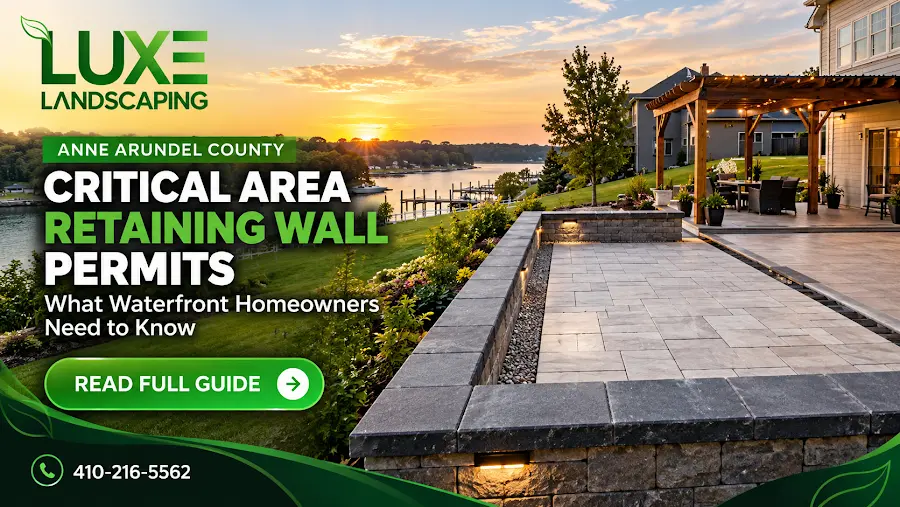
Owning waterfront property in Anne Arundel County comes with incredible views, but projects near the Chesapeake Bay and its tidal tributaries often require more planning than ordinary backyard improvements.
If erosion, a changing slope, or unstable soil has you considering a retaining wall, one of the first questions should be whether a permit is required.
A Critical Area retaining wall permit in Anne Arundel County can involve County building requirements, Critical Area review, and, for certain shoreline projects, Maryland wetland or waterway approvals. The exact process depends on where the wall is located, how tall it is, and whether it functions as a normal landscape retaining wall or as shoreline erosion protection.
Luxe Landscaping helps homeowners plan retaining walls and seating walls as part of functional and attractive outdoor spaces throughout Anne Arundel County.
What Is the Chesapeake Bay Critical Area?
Anne Arundel County defines the Chesapeake Bay Critical Area as land and water generally extending 1,000 feet landward from tidal waters or tidal wetlands. Within that area, additional environmental rules can apply to development, clearing, grading, and shoreline work.
The County also identifies a Critical Area Buffer that generally extends 100 feet landward from tidal waters, tributary streams, or tidal wetlands. Activities close to the shoreline can therefore receive significantly more regulatory review than similar work farther inland.
This matters for waterfront properties in areas such as Annapolis, Severna Park, Edgewater, Shady Side, Galesville, West River, Gibson Island, and other communities bordering the Chesapeake Bay and its tributaries.
Do You Need a Permit for a Retaining Wall in Anne Arundel County?
The answer depends partly on the wall's height and location.
Anne Arundel County currently states that residential retaining walls over 24 inches require a permit. The County classifies residential retaining walls under its Residential Accessory Structure permitting process.
A smaller wall may not require the same retaining wall building permit under the general height rule, but that does not automatically mean a waterfront project can proceed without review.
Why Waterfront Location Changes the Answer
A wall located inside the Critical Area, within the shoreline Buffer, near wetlands, or directly along tidal water may be subject to additional requirements.
For that reason, the question "Do you need a permit for a retaining wall?" cannot be answered using height alone when the property is near the Chesapeake Bay.
Before construction, homeowners should determine:
- Whether the property lies within the Critical Area
- Whether the work is inside or near the 100-foot Buffer
- The proposed retaining wall height
- Whether grading or vegetation removal is required
- Whether the structure will affect tidal wetlands or tidal water
- Whether the wall is intended to stabilize an upland slope or directly protect the shoreline
These details can change the approval path.
Is a Shoreline Retaining Wall Different From a Landscape Retaining Wall?
Yes, and the distinction is important.
A typical landscape retaining wall holds back soil, creates usable grades, supports a patio area, or manages elevation changes within a yard.
A wall installed directly along the water to resist waves, tides, and shoreline erosion may instead function as a bulkhead, seawall, revetment, or another shoreline erosion control structure.
Anne Arundel County specifically requires permits for residential bulkheads and riprap used for shoreline protection. Maryland also regulates construction that alters tidal wetlands or involves shore erosion control structures.
A Waterfront Retaining Wall Permit in Maryland May Involve Several Agencies
For projects affecting tidal wetlands or tidal waters, the Maryland Department of the Environment provides a Joint Federal/State application process for tidal projects.
Required information can include plans, project details, and documents related to shoreline stabilization. The exact approvals depend on the proposed work and site conditions.
Structural Shoreline Protection Has Additional Considerations
Maryland generally favors living shoreline approaches for shoreline erosion protection. MDE states that nonstructural shoreline stabilization is the preferred method unless a project qualifies for a waiver allowing structural stabilization.
Site factors such as erosion severity, water depth, wave energy, and shoreline conditions may influence whether a structural solution is appropriate.
This is one reason homeowners should avoid assuming that a conventional wall can simply be installed at the water's edge.
What Are the Chesapeake Bay Shoreline Permit Requirements?
Chesapeake Bay shoreline permit requirements depend on the type of work proposed.
For a project in Anne Arundel County, homeowners may encounter several layers of review.
County Building Review
A retaining wall over the County's permitting threshold normally requires a building permit.
Anne Arundel County's residential accessory structure guidance lists documentation that may include:
- Construction plans
- A site plan
- A Critical Area Worksheet
- A standard grading plan application
The County notes that not every listed document is required for every project. Requirements depend on the specific proposal.
Critical Area Review
Projects inside the Critical Area may need to demonstrate compliance with rules concerning land disturbance, lot coverage, vegetation, grading, and the shoreline Buffer.
The closer the work is to tidal water or wetlands, the more important early site planning becomes.
State Wetlands and Waterways Review
If a project affects tidal wetlands, tidal waters, or shoreline erosion control, Maryland approvals may also be required.
Maryland regulates activities including filling, dredging, bulkheads, revetments, shoreline stabilization, and similar structures in tidal wetland areas.
Why Is Shoreline Erosion Control Reviewed Differently?
Waterfront erosion is not only a landscaping issue. Shoreline work can affect water quality, habitat, neighboring properties, sediment movement, and the natural function of the Chesapeake Bay shoreline.
Anne Arundel County's shore erosion guidance establishes a preference for vegetative approaches before harder structural methods. Alternatives can progress from vegetation and stone sills to beach nourishment, riprap, and, where appropriate, bulkheads or seawalls.
That does not mean every waterfront property must use the same solution.
A steep, highly exposed shoreline may need a different approach than a protected creek with gentle wave action. Site evaluation should come before material selection.
What Should Homeowners Do Before Planning a Waterfront Wall?
The best time to think about permitting is before the design is finalized.
Confirm Where the Property Sits
Start by determining whether the proposed work falls within the Critical Area or the 100-foot Buffer.
Anne Arundel County provides Critical Area and Buffer mapping resources for property research.
Identify the Actual Problem
A retaining wall should solve a specific site issue.
Common concerns include:
- Soil erosion
- Failing existing walls
- Steep slopes
- Poor drainage
- Loss of usable yard area
- Shoreline movement
- Grade changes around patios or walkways
The right solution depends on the cause, not simply the appearance of the property.
Consider Drainage Early
Water pressure behind a retaining wall can contribute to movement or failure when drainage is not properly addressed.
For waterfront properties, surface drainage should also be considered in relation to erosion and runoff toward the Chesapeake Bay.
Avoid Starting Work Before Required Approvals
Building first and asking about permits later can create expensive problems.
Anne Arundel County lists penalties for certain unpermitted construction, including unauthorized pier or bulkhead work.
Homeowners should verify applicable County and State requirements before excavation begins.
Can a Retaining Wall Be Part of a Larger Outdoor Living Project?
Absolutely.
Many retaining walls are not located directly on the shoreline. They may be used farther upland to create level areas for patios, walkways, planting beds, or entertaining spaces.
For example, a sloped waterfront backyard might combine a retaining wall with custom outdoor living spaces, steps, planting, and a paver patio or walkway.
Planning these features together helps ensure the elevations, drainage, circulation, and overall landscape design work as one system.
Homeowners can also review completed Luxe Landscaping projects for ideas before deciding how they want to use their property.
Planning a Retaining Wall in Anne Arundel County?
A Critical Area retaining wall permit in Anne Arundel County can be straightforward for some properties and considerably more involved for waterfront sites.
The important first step is understanding what type of wall you actually need.
A landscape wall several hundred feet from the shoreline may follow a different process from a structure designed to stop erosion directly beside tidal water. Height, grading, vegetation impacts, wetlands, shoreline location, and construction methods all matter.
Luxe Landscaping works with homeowners throughout Anne Arundel County on retaining walls, hardscaping, planting, and larger outdoor living projects. You can also view Luxe Landscaping's Google Business Profile and customer reviews while researching your project.
If your property has erosion, slope, drainage, or outdoor living challenges, contact Luxe Landscaping to discuss the site and determine the appropriate next steps before construction.
Frequently Asked Questions
Do you need a permit for a retaining wall in Anne Arundel County?
Anne Arundel County states that residential retaining walls over 24 inches require a permit. Waterfront and Critical Area projects can also trigger additional review depending on the location and type of work.
What is a Critical Area retaining wall permit in Anne Arundel County?
It generally refers to permitting for retaining wall work on property located within the Chesapeake Bay Critical Area. The exact review may involve building, grading, environmental, or Critical Area requirements depending on the project's location and scope.
Do I need a retaining wall building permit for a wall near the Chesapeake Bay?
Possibly. Wall height matters, but proximity to tidal water, wetlands, and the Critical Area Buffer can introduce additional requirements. A shoreline stabilization structure may also require State authorization.
Does a waterfront retaining wall permit in Maryland cover shoreline erosion work?
Not necessarily through one single permit. Shoreline erosion control projects can involve County approvals and Maryland tidal wetlands or waterways authorization. MDE uses a Joint Federal/State application process for many tidal projects.
Can I install a seawall instead of a living shoreline?
Not automatically. Maryland generally prefers living shoreline methods for shoreline stabilization, and structural shoreline protection may require a waiver when applicable. Site conditions help determine which solution can be approved.
How can I find out whether my property is in the Critical Area?
Anne Arundel County provides Critical Area and 100-foot Buffer mapping resources. Properties generally within 1,000 feet of tidal waters or tidal wetlands are considered part of the Critical Area.
Who should I contact before building a waterfront retaining wall?
Start by confirming requirements with the appropriate Anne Arundel County permitting and planning offices. Projects affecting tidal waters or wetlands may also require coordination with the Maryland Department of the Environment. For the construction and landscape side of the project, Luxe Landscaping can help evaluate how a retaining wall fits into the broader property design.

Ready to Transform Your Backyard?